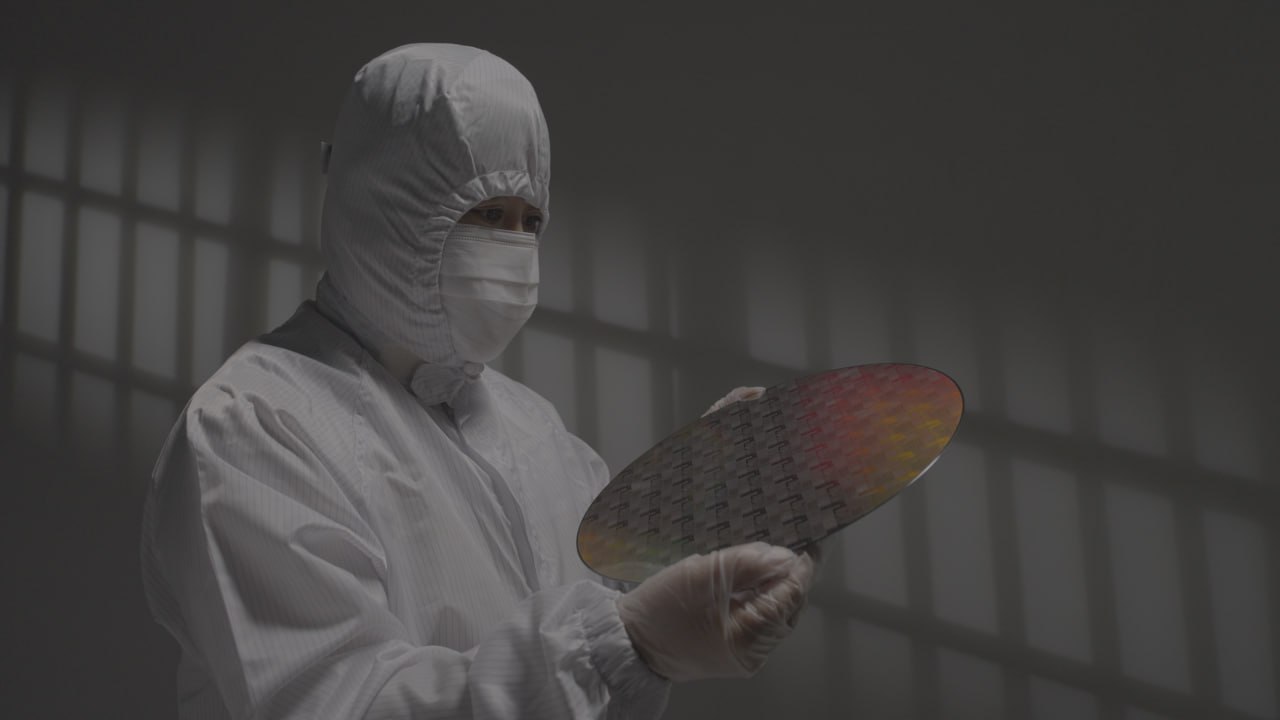
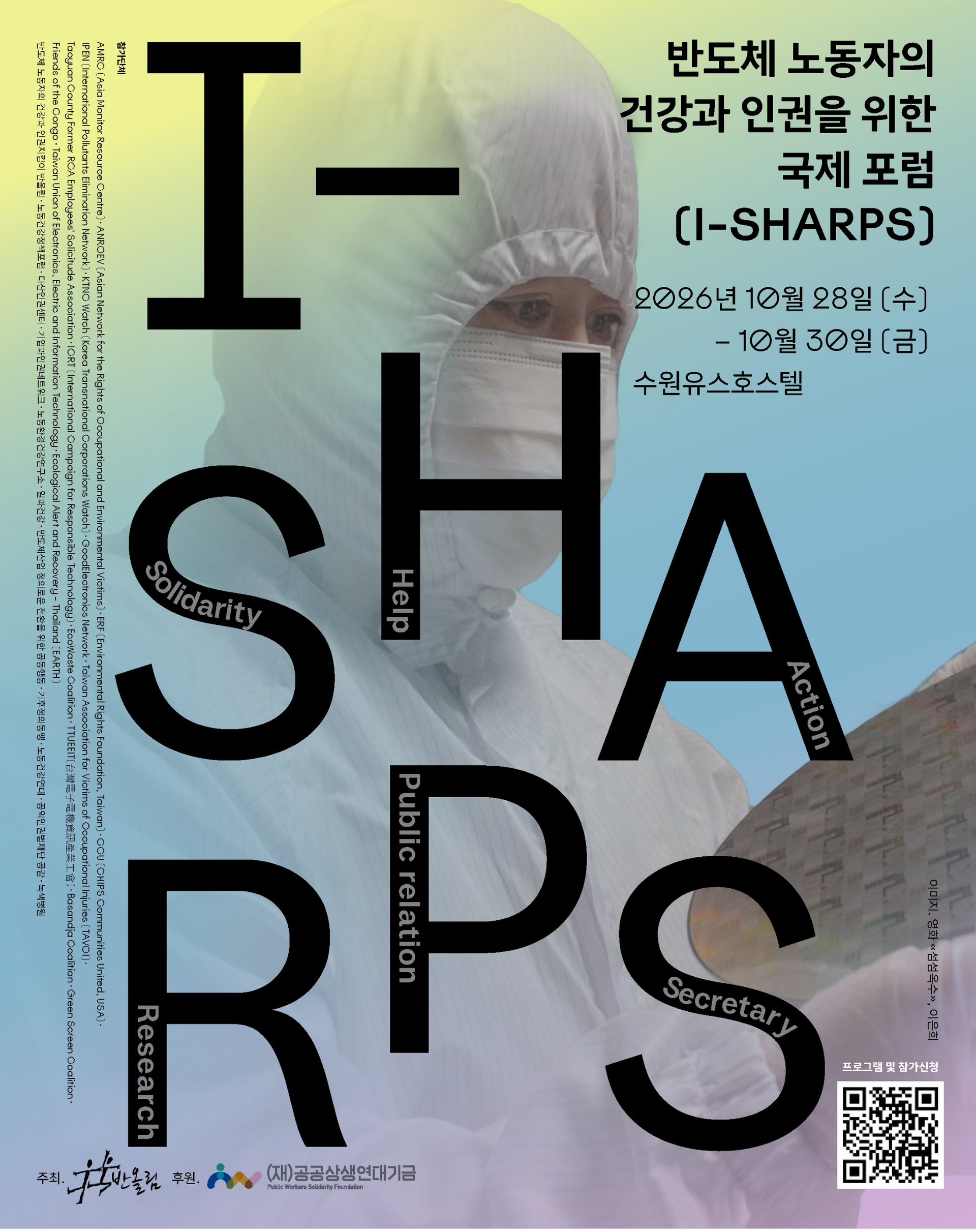
I-SHARPS 2026 International Forum
Dates : October 28 (Wed) – October 30 (Fri), 2026
Location : Suwon Youth Hostel, Korea
Poster : SON Heiin designer
Background
The semiconductor industry has become one of the key drivers of the AI era and digital transformation. Governments around the world are investing heavily in semiconductors as strategic national industries, while multinational corporations continue to expand manufacturing facilities and global supply chains.
Behind this remarkable growth, however, lie serious human rights concerns, including occupational diseases, exposure to hazardous chemicals, environmental pollution affecting surrounding communities, labor rights violations throughout supply chains, and inadequate chemical safety management. Although semiconductor manufacturing is fundamentally a chemical-intensive industry involving thousands of hazardous substances, workers' right to know and access to information about the chemicals they handle remains insufficiently protected in many countries. Women workers continue to face occupational diseases and reproductive health risks. At the same time, hazardous work is increasingly outsourced to subcontracted and migrant workers, while environmental contamination, restrictions on freedom of association, and labor rights violations remain persistent challenges across the global semiconductor industry.
To respond to these shared challenges, SHARPS is organizing the I-SHARPS 2026 International Forum on Semiconductor Workers' Health and Human Rights, bringing together workers, occupational disease victims, trade unions, civil society organizations, researchers, and advocates from around the world to establish a global platform for solidarity.
Agenda
Xiaowei Wang(Northwestern University), Lee Jong-Ran(SHARPS), Nien yun (TAVOI), Fahmi Panimbang(International Campaign for Responsible Technology (ICRT)
Kawon(climate justice alliance), Judith Barish(CHIPS Communities United), TANG,LIN-HSIANG(Environmental Rights Foundation), Hyeonjung Lee(Joint Action for a Just Transition in the Semiconductor Industry )
Won Kim(Wonjin Institute for Occupational and Environmental Health), Sangsu Lee(SHARPS),CHINKIE PELINO GOLLE( International Pollutants Elimination Network (IPEN)), Kyungseok Lee(Center for Worker’s Health and Safety)
Marie Therese Png(Basandja Coalition / Green Screen Coalition), Maurice Carney(Friends of the Congo) Petna Ndaliko Katondolo(Basandja Coalition)
Hyunjoo Kim(Labor Health Policy Forum), Myounghee Kim (Solidarity for Workers’ Health) , Seoung-gyu Jo(SHARPS), Rochelle Porras(Good Electronics)
Pillkyu Hwang(GongGam Human Rights Law Foundation),Chang-gi Kang, Hyunjun Yang(KTNC Watch (Korean Transnational Corporations Watch))
Ralra(Dasan humanrights center), Hyunjoo Kim(Labor Health Policy Forum), Seon-kyeong Kim, Hyangsuk Jung(SHARPS)
Ray(TUEEIT/TTNC watch), Judith Barish(CHIPS Communities United), TANG,LIN-HSIANG(Environmental Rights Foundation) Nien yun (TAVOI), Chin-Chu Tu 杜津珠 (Taoyuan County Former RCA Employees' Solicitude Association), Feng-Chu Lu 盧鳳珠 (Taoyuan County Former RCA Employees' Solicitude Association) Yao Lin Liu(TUEEIT)
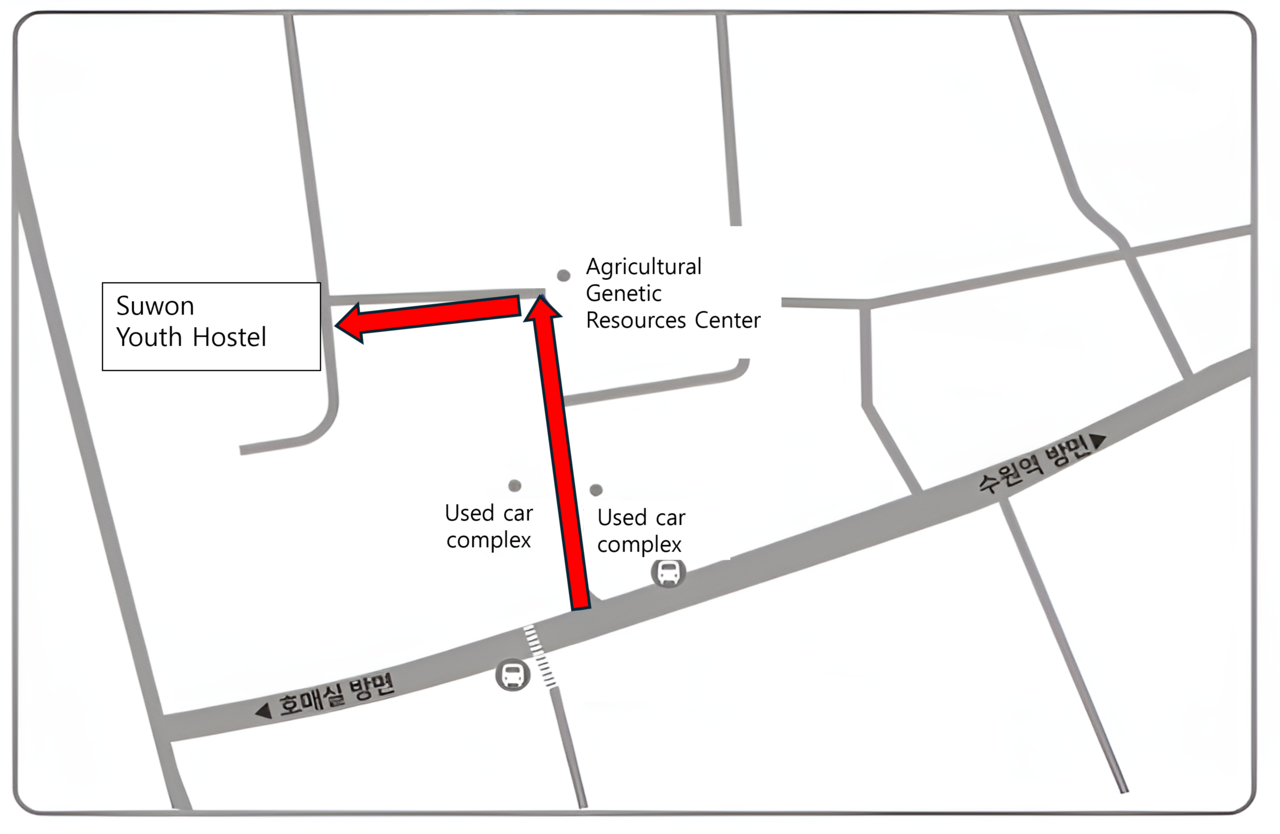
Directions
Suwon Youth Hostel
The Forum aims to serve as a starting point for building a global framework for cooperation,
ensuring that the rapid growth of the semiconductor industry in the AI era is accompanied
by equal progress in protecting workers' health, human rights, and the environment.